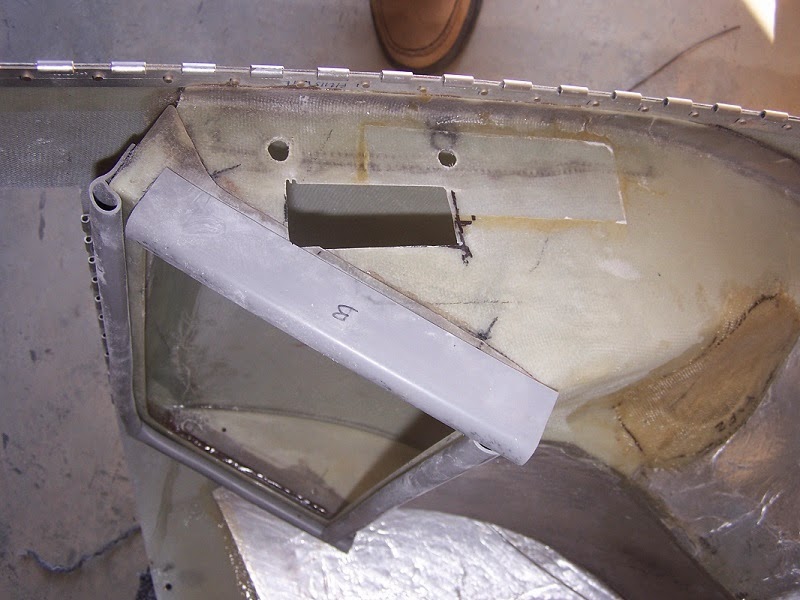
After investigating a few builder's sites, I conclude that there is no standard way to trim the fiber arm regarding the covering of the cavity behind the pivot bolt. Here are a few examples of trimmings:
Conclusion: you are on your own, do your best to make it look good and clear of interference.
Vieille Burette RV-12 Build Site
Building an RV-12 LSA from a kit by VANs aircraft and learning to fly Light Sport Aircrafts = the full Wright Brothers experience!
Wednesday, May 9, 2012
Friday, May 4, 2012
What about an electric powered RV-12?
Dick Van Grunsven must have already mulled this idea...
I believe the RV-12 is a good platform for it: lots of room for batteries in the tank and firewall forward areas once you get rid of the Rotax. Plus at $27K for the engine, you can buy lots of batteries with the money left after buying a $5K electric motor.
Major firms join electric aircraft discussion
I believe the RV-12 is a good platform for it: lots of room for batteries in the tank and firewall forward areas once you get rid of the Rotax. Plus at $27K for the engine, you can buy lots of batteries with the money left after buying a $5K electric motor.
Major firms join electric aircraft discussion
Wednesday, May 2, 2012
A bad start after a nice vacation break!
Returning from a nice Spring break in Hawaii, I got back to my canopy fiber work, sanding and filling and sanding etc... Then came the trimming time and here is the result:
Left side looks fine, the cavity behind the front arm is well closed:
Right side is bungled, there is a gap, oh nooooo! :
Warning for other builders: my mistake was to trust the trimming template provided by VANs. Not that there is anything wrong with it (as Seinfeld would say) but you have to be careful in the positioning of the template. I was off 1/8 of an inch vertical and horizontal. I will need help to make the repair (as I did for the initial fiber layout) but it's doable as fiber is easy to repair... with time and patience.
I believe that VANs is a bit light on instructions concerning fiber work and they could have warned about this potential pitfall.
Left side looks fine, the cavity behind the front arm is well closed:
Right side is bungled, there is a gap, oh nooooo! :
Warning for other builders: my mistake was to trust the trimming template provided by VANs. Not that there is anything wrong with it (as Seinfeld would say) but you have to be careful in the positioning of the template. I was off 1/8 of an inch vertical and horizontal. I will need help to make the repair (as I did for the initial fiber layout) but it's doable as fiber is easy to repair... with time and patience.
I believe that VANs is a bit light on instructions concerning fiber work and they could have warned about this potential pitfall.
Saturday, April 7, 2012
A Humbling Ceremony Honoring a Local Hero
It was a beautiful spring day at Gilliam McConnell airport in Carthage, NC to celebrate a hero.
This is his story:
Yes, I was there with my Flying Tiger tee shirt, bought at Oshkosh in 1991!
... and not alone:
The Chinese delegation from Hunan province:
2nd Lt. Robert Hoyle Upchurch:
This is his story:
Yes, I was there with my Flying Tiger tee shirt, bought at Oshkosh in 1991!
... and not alone:
The Chinese delegation from Hunan province:
2nd Lt. Robert Hoyle Upchurch:
Friday, April 6, 2012
Canopy fairing's fiberglass work
I just completed the following instruction pages:
Lacking any experience in fiberglass and resins work, I asked an expert for help. Roger Fowler, a member of EAA 1114 is an avid glider pilot but also a certificated repairman for gliders that are mostly composite these days. Roger helped me choosing the proper materials and tools and showed me how to work the resin and fabric together in the lay up. There were up to 10 plies in some areas that needed to be positioned in overlays and wet out with resin. We had two sessions for a total of 4 hours of lay out (the instructions say 7 hours total, the difference is due to Roger's skills and experience).
Now the epoxy is curing but the work is not over as lots of sanding, surface smoothing and filling still has to be done to have a finished canopy, good for the paint shop.
This is how it looks while curing:
Lacking any experience in fiberglass and resins work, I asked an expert for help. Roger Fowler, a member of EAA 1114 is an avid glider pilot but also a certificated repairman for gliders that are mostly composite these days. Roger helped me choosing the proper materials and tools and showed me how to work the resin and fabric together in the lay up. There were up to 10 plies in some areas that needed to be positioned in overlays and wet out with resin. We had two sessions for a total of 4 hours of lay out (the instructions say 7 hours total, the difference is due to Roger's skills and experience).
Now the epoxy is curing but the work is not over as lots of sanding, surface smoothing and filling still has to be done to have a finished canopy, good for the paint shop.
This is how it looks while curing:
Saturday, March 31, 2012
Skyview on the way!
Well, kind of... I received yesterday notification by VANs that shipping is 3 to 4 weeks from now. That would put it in my shop by the end of April. Glad I did not receive VANs letter on April 1st!
Monday, March 26, 2012
Useful Aviation weekend despite bad weather
It started on Friday, on my way to West Jefferson. Stop at Salisbury/Rowan Cty- KROC Airport for a transition training session on Sportcruiser with Davey Amos. My plan was to fly to Jefferson (Ashe Cty -KGEV) airport and back after a few touch & go at GEV. The weather was quite interesting with several layers of cloud up to 9500ft. Thanks to Davey's experience, we found our way between the clouds while checking the METARS live from the satellite weather receiver which is part of the Sportcruiser equipment (It is the same Garmin 496 GPS that equips current RV-12 glass panel before the Skyview upgrade). As the weather was becoming more and more questionable for VFR flight, we headed back right after landing at GEV. Flew at 9500ft on the way back, close to my Sport Pilot limit of 10K ft!
In West Jefferson it was rain and T-Storms all over the weekend. I spent most of Saturday and part of Sunday in the GEV hangar of Kim, assisting him building the first RV-12 Super Rack based on my prototype. It went pretty well considering that it was the first built on the plans I had just finalized from the prototype that's visible in the You Tube Videos. After shopping at Lowe's for all the needed parts (total bill about $100) we spent 3 hours cutting lumber and a total of 6 hours building the Super Rack. We only had a circular saw and drills for tools. I think that with a well equipped workshop (with Miter Saw, Table Saw and Drill Press), the job could be done in a total of 8 hours including one hour of shopping for parts.
Once finished Kim put the Super Rack to task, removing and mounting back a wing in about 30 minutes. I believe that with practice this can be halved. I also believe that the Super Rack is a valuable tool even for those who have space in their hangar. The reason Kim was interested in having one if for his yearly inspection that require removing both wings. Not depending on anybody to do the job is an important freedom specially at small airports like GEV. An additional benefit of the Super Rack is that once the wings are on the rack, being stowed vertically is safer and takes much less room in the hangar than having them horizontal on stands. While at Salisbury Friday, I dropped at the airport paint shop where an RV-12 was being painted. What I saw was a painted RV-12 except for one wing that had only half the skins painted. The other half was made of brand new skins. The wing had been bumped into while laying on stands and fell on the ground. An expensive paint job for the shop owner who showed some interest in my Super Rack!
In West Jefferson it was rain and T-Storms all over the weekend. I spent most of Saturday and part of Sunday in the GEV hangar of Kim, assisting him building the first RV-12 Super Rack based on my prototype. It went pretty well considering that it was the first built on the plans I had just finalized from the prototype that's visible in the You Tube Videos. After shopping at Lowe's for all the needed parts (total bill about $100) we spent 3 hours cutting lumber and a total of 6 hours building the Super Rack. We only had a circular saw and drills for tools. I think that with a well equipped workshop (with Miter Saw, Table Saw and Drill Press), the job could be done in a total of 8 hours including one hour of shopping for parts.
Once finished Kim put the Super Rack to task, removing and mounting back a wing in about 30 minutes. I believe that with practice this can be halved. I also believe that the Super Rack is a valuable tool even for those who have space in their hangar. The reason Kim was interested in having one if for his yearly inspection that require removing both wings. Not depending on anybody to do the job is an important freedom specially at small airports like GEV. An additional benefit of the Super Rack is that once the wings are on the rack, being stowed vertically is safer and takes much less room in the hangar than having them horizontal on stands. While at Salisbury Friday, I dropped at the airport paint shop where an RV-12 was being painted. What I saw was a painted RV-12 except for one wing that had only half the skins painted. The other half was made of brand new skins. The wing had been bumped into while laying on stands and fell on the ground. An expensive paint job for the shop owner who showed some interest in my Super Rack!
Subscribe to:
Posts (Atom)